The Long Way Round to Your First Hundred: Training, Weather and Fundraising Without the Panic
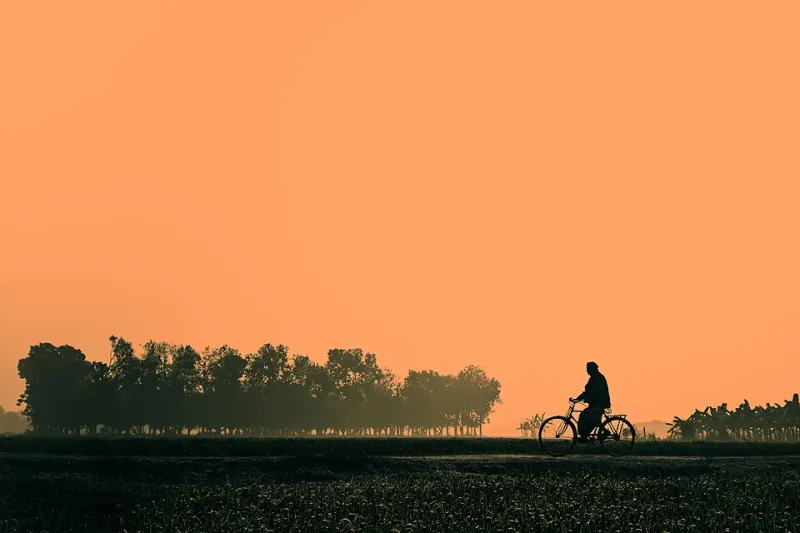
Photo: Ashikul Islam Anik, CC BY-SA 4.0, via Wikimedia Commons
Most UK sportive entries go live while it's still dark by four in the afternoon, which means the gap between 'I've signed up' and 'I'm riding a hundred miles' gets filled with turbo sessions, porridge and a low-level background hum of doubt. If 2026 is the year you take on your first charity century, here's the plan we'd hand you in week one: unglamorous, weather-proofed and built around the fact that you have a job.
Start with honest maths
First-timers usually overestimate the miles they need and underestimate the hours they'll realistically get. Three rides a week is the sweet spot: one long ride, one hilly or effort-based session, one short easy spin. If life only allows two, make the long ride non-negotiable and squeeze a 45-minute spin in wherever you can.
You do not need to ride 100 miles before the event. You need to arrive at the start line having done 75 to 85 miles a couple of times, with a body that knows how to eat, drink and keep going. That's it.
| Block | Weeks | Long ride | Weekly time | Focus |
|---|---|---|---|---|
| Base | 1–4 | 30–50 miles | 4–5 hours | Consistency, comfort, habits |
| Build | 5–8 | 50–70 miles | 5–7 hours | Hills, fuelling, pacing |
| Peak | 9–11 | 75–85 miles | 7–9 hours | Dress rehearsals |
| Taper | 12 | 25–40 miles | 3–4 hours | Rest, logistics, nerves |
Weeks 1–4: base miles and boring wins
The temptation is to smash it in January. Resist. These four weeks are about turning three rides a week into a routine you don't argue with. Keep the pace conversational — you should be able to talk in full sentences — and build the long ride from around 30 miles to 50 by the end of the block.
Use this time to sort the things that will otherwise ruin a long day out: saddle position, padded shorts you actually trust, a bike fit if your shoulders or knees complain, and a phone mount or route device you can read without stopping. Ten minutes of stretching or core work twice a week sounds trivial and isn't.
Write it down. A cheap wall chart or a free training app both work. Seeing four weeks of ticks does more for your confidence than any motivational video.
Weeks 5–8: hills, distance and eating on the move
Now add climbing. Find a local hill of three to five minutes and do repeats — five efforts, riding up in a gear you can spin rather than grind, rolling back down to recover. If you live somewhere flat, ride into the wind instead. It's the same training effect with worse scenery.
The long ride climbs from 50 to around 70 miles. This is also when you practise fuelling properly rather than hoping a single bottle and a banana will carry you. Eat something every 30 to 40 minutes, starting before you feel hungry, and drink little and often.
Midweek, a shorter session with some tempo — 20 to 30 minutes at a pace that's comfortably hard — will do more for your century than another gentle spin.
Weeks 9–11: dress rehearsals
Two long rides in this block, ideally on terrain that resembles the event. If your ride is in the Yorkshire Dales or the Peak District, don't do all your long training on flat fen roads. If it's a flattish coastal route, don't panic about climbing.
Treat these as full rehearsals: same shorts, same socks, same food, same shoes. Nothing new on event day is a cliché because it's true. If a gel flavour turns your stomach at mile 60 in training, better to find out now.
Week 12: taper, pack, don't fettle
The final week is for rest, logistics and a couple of easy spins. Check your transport to the start, your accommodation if you're travelling, and your kit bag. Do not decide to adjust your brakes the night before the ride. Many a century has been derailed by an enthusiastic eleventh-hour mechanic.
Riding through a British spring without misery
There is no such thing as bad weather, only the wrong kit — but also, sometimes it's genuinely too icy, and the turbo is the sensible answer. Aim for layers you can shed: a base layer, a jersey, arm warmers, a packable waterproof and, in cold months, overshoes and full-finger gloves. Clear or yellow lenses help on grey days when spray makes everything look like a watercolour.
If you're riding in a group, mudguards are a courtesy, not a fashion statement. Check the Met Office before long rides, and have a shorter loop in your back pocket for days when the forecast turns. Flooded lanes and gravel-strewn corners after rain deserve respect, not bravery.
Joining a local club ride — British Cycling affiliated clubs and CTC groups are good starting points — will teach you more about group riding in three Sundays than three months of solo miles. Learn the hand signals, don't half-wheel, and call out potholes.
Fuel that works at a village hall feed station
Most UK sportives lay on proper food: malt loaf, flapjack, bananas, salted crisps, jelly babies, tea, and occasionally beans on toast. It's decent fuel. Aim for 60g of carbohydrate an hour on longer rides once you're conditioned to it, plus 500 to 750ml of fluid per hour depending on the temperature, with electrolytes if it's warm or you're a heavy sweater.
Use training rides to work out what your stomach tolerates. Some riders thrive on real food; others need gels. Neither is morally superior.
A ten-minute bike check
Run the M-check before every long ride: wheels, tyres, brakes, chain, bolts, saddle and headset. Carry two spare tubes, tyre levers, a multi-tool, a pump or CO2, a phone, a tenner, a card and ID with an emergency contact. Lights are legally required at night and just sensible in gloom.
Turning miles into donations
This is the part people leave until the last fortnight, and it's the part your chosen charity will thank you for doing early.
- Week 1: Set up your fundraising page — JustGiving, Enthuse or your charity's own platform — and write 100 honest words about why you're riding. Specific beats grand.
- Week 4: First ask, to close friends and family. Don't wait until you've 'earned' it by training. People give to people.
- Week 6: Post a training milestone. 'Fifty miles in the rain for [charity]' is a better update than a generic link.
- Week 8: Ask your employer about matched giving, and consider a pub quiz, bake sale or office sweepstake — check your charity's rules on raffles and licensing first.
- Week 10: Final push, plus a reminder that UK taxpayers can add Gift Aid, worth an extra 25p per £1 to the charity.
- Week 12: Thank everyone individually or in a proper round-up.
On target-setting: many UK charity cyclists raise somewhere between £250 and £750. Pick a figure that stretches you without making the page feel like a demand. Be clear about where the money goes, and check the wording with your charity so nothing overpromises.
Your checklist
- Entry confirmed and event route downloaded
- Three rides a week in the diary
- Saddle and shorts dialled in
- Fuelling plan tested on at least three long rides
- Bike serviced at least two weeks before the event
- Fundraising page live with a photo and a reason
- Travel and start-time logistics sorted
- Emergency contact on your phone lock screen
On the day
Start slower than feels right. Eat before you're hungry, drink before you're thirsty, and ride your own pace rather than chasing a wheel you'll regret at mile 80. Use the last feed stop even if you feel fine. And when the finish banner appears, remember the reason you signed up in the first place — the miles were the method, not the point.